Home · Retailers · Wayfair

Wayfair sales and shelf tracking for home improvement brands

Wayfair ranks by shopper behavior rather than a planogram, and a class page can reorder without warning. See where your products land, and who is paying to sit above them.

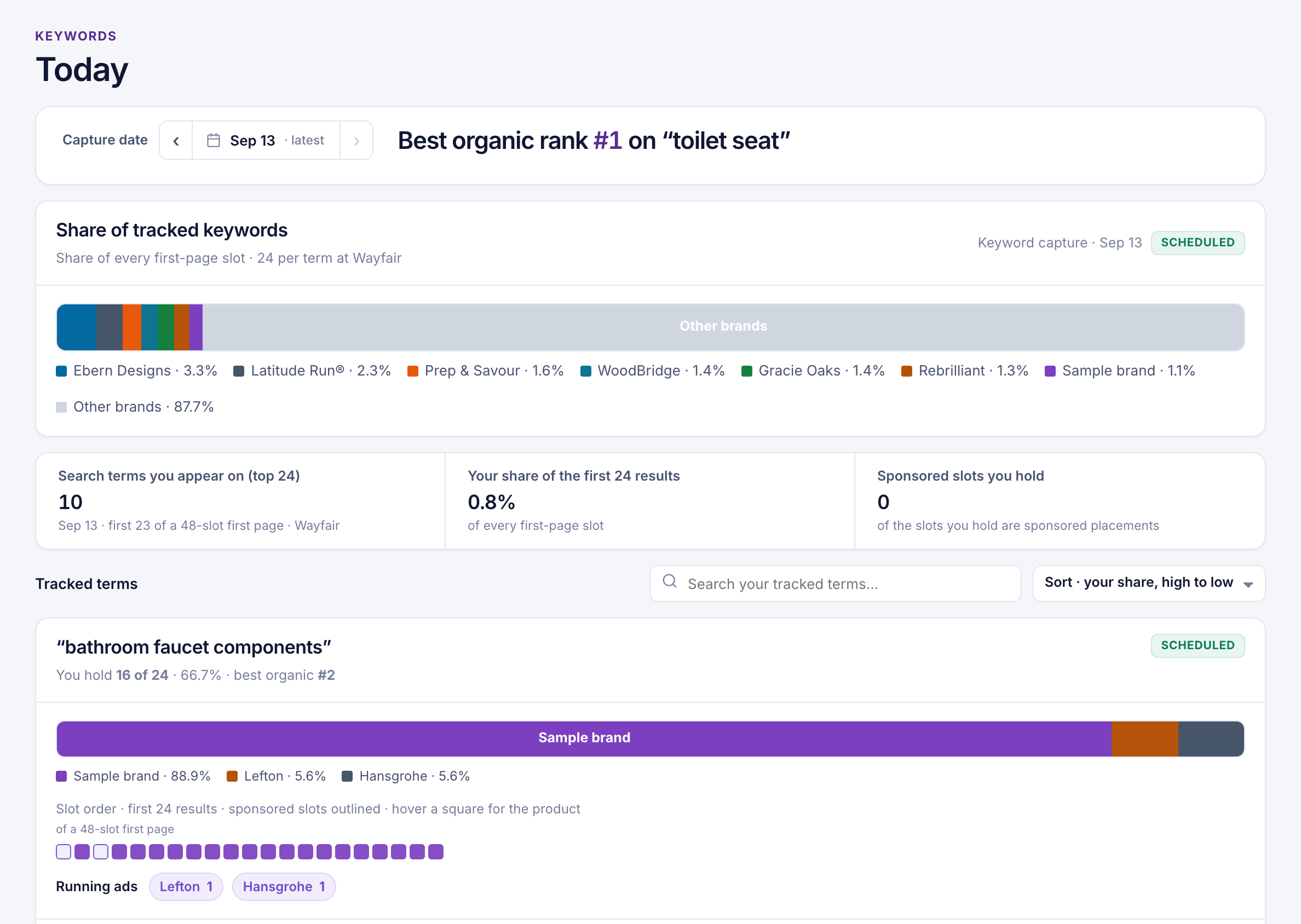
Keywords for kitchen faucets at Wayfair, in a Metrics workspace for a sample brand
Keywords Sample brand
  • Your place on Wayfair category pages, and who holds the places around it
  • Where you rank in Wayfair search, with organic and paid kept apart
  • Which places on the page were paid for, and by whom
  • What Wayfair shows your products priced at

What is a Wayfair sales tracker for home improvement brands?

A view of a brand’s position on Wayfair’s browse pages and search results, on a marketplace where most sellers hold their own inventory and the catalog reorders by engagement rather than a fixed planogram. It tracks the shelf, not sales figures Wayfair does not publish.

Defend

Watch a browse class that can reorder without warning, since Wayfair’s catalog is not a fixed planogram.

Optimize

See which of Wayfair’s promotional and paid formats are actually reaching your category, and which are not.

Grow

Find the pure-play competitors that only show up on Wayfair and nowhere else in your usual competitive set.

What it looks like on Wayfair

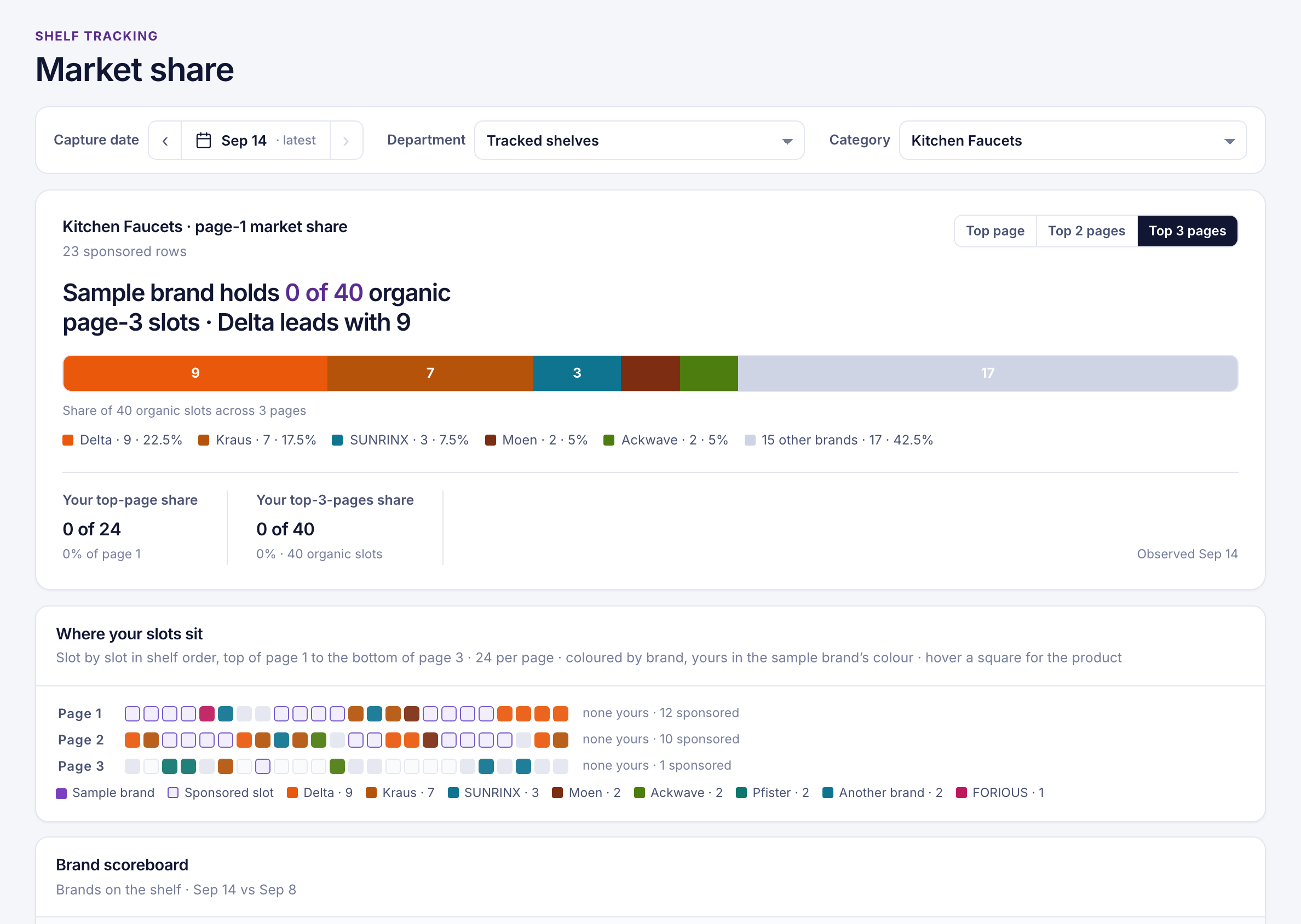
A sample brand’s workspace, tracking kitchen faucets on Wayfair. The shelf shows where each product sits on page one, and who holds the places around it. Category market share shows every brand’s share of the shelf, the retailer’s own brands included.
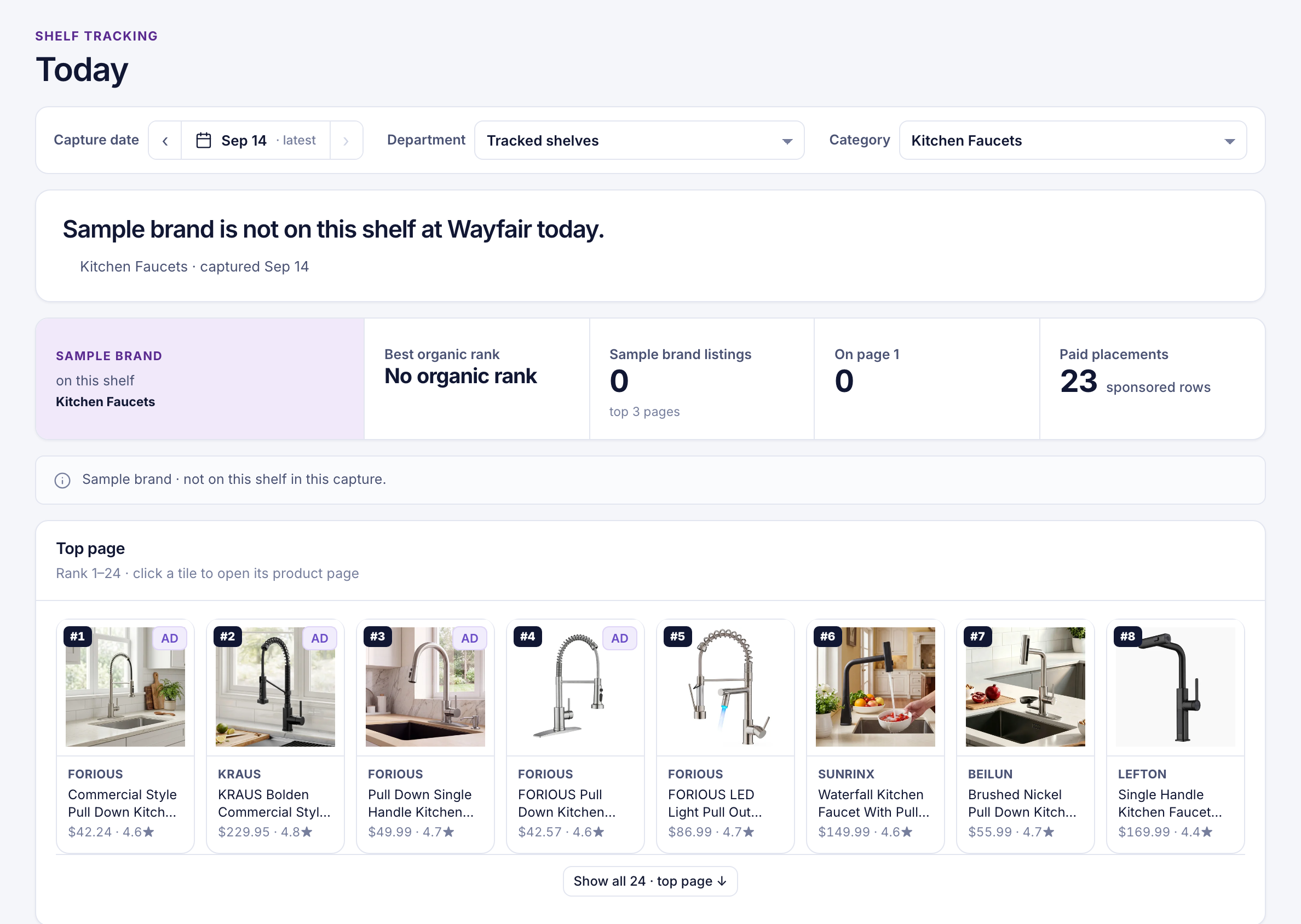
The shelf for kitchen faucets at Wayfair, in a Metrics workspace for a sample brand
The shelf Sample brand
Category market share for kitchen faucets at Wayfair, in a Metrics workspace for a sample brand
Category market share Sample brand

How selling on Wayfair works.

Wayfair runs no traditional buying office. Most supply is dropship: Wayfair passes the customer order straight through to the supplier's own warehouse, and the supplier picks, packs and ships to the customer.

The full picture, and 20 specifics about Wayfair

Suppliers that cannot dropship can use CastleGate, Wayfair's own warehousing and fulfillment network, instead. Either way Wayfair, not the supplier, sets the retail price the shopper sees. The supplier sets its own wholesale cost, and Wayfair folds in shipping and handling to produce one all-in customer price. Wayfair also controls the final listing: it constructs the product title, orders the images and optimizes the variant set from the data a supplier submits. A brand's terms of trade at Wayfair therefore run through wholesale cost and content submission rather than a negotiated assortment or a self-set retail price.

  • On Wayfair, most listings are fulfilled dropship: a customer order becomes a purchase order sent straight to the supplier's own warehouse, and the supplier picks, packs and ships to the customer directly. Sell With Wayfair, Beginner's Guide
  • Suppliers unable to dropship can use CastleGate, Wayfair's own logistics network, for warehousing and fulfillment; trade press reporting dates CastleGate's build-out to 2015. Sell With Wayfair, CastleGate Overview
  • A supplier sets only its wholesale base cost. Wayfair covers shipping and handling and sets the final retail price the shopper sees. Sell With Wayfair, Beginner's Guide
  • Wayfair constructs the product title, orders product images, and optimizes the option and variant set itself from the raw data and images a supplier submits. Sell With Wayfair, Beginner's Guide
  • Suppliers are paid Net 60 by default, or can opt into Quick Pay for a 2 percent discount to be paid within 30 days. Sell With Wayfair, Beginner's Guide
  • Wayfair excludes certain categories from third-party listing, including exercise and cardio equipment, medical devices, baby items like rattles and pacifiers, bicycles and skateboards, power tools, furs, and computer software and hardware. Sell With Wayfair, Beginner's Guide
  • Wayfair organizes its catalog into product classes rather than store aisles; a single supplier catalog (Item Spec Sheet) upload can span up to 15 different classes, each with its own attributes. Sell With Wayfair, Beginner's Guide
  • Wayfair ranks browse and search results using a Bayesian model that separates a product's own appeal from the visibility boost of its page position, drawing on clicks, add-to-cart, and add-to-registry behavior in addition to orders, and uses Thompson sampling to balance proven performers against giving newer products a chance to be seen. About Wayfair, Bayesian Product Ranking at Wayfair
  • Baymard Institute cites Wayfair as an example of a retailer whose customer-rating sort weighs both the rating average and the number of ratings, so a lower-average item with many ratings can outrank a 5-star item with very few. Baymard Institute, Sort with Both Ratings Average and Number of Ratings
  • A Partner Home tooling update lets suppliers view and edit an individual variant and its parent SKU together on one page, and assign distinct customer-facing names to variants, for example distinguishing a Blue Chair from a Red Chair. Sell With Wayfair, Merchandising Tool Update
  • Sponsored Products is Wayfair's pay-per-click, self-service ad format that elevates a supplier's products in on-site search and browse results. Sell With Wayfair, Advertising
  • Sponsored Shops is a banner-ad format that places a supplier's brand page, a promotion, or a browse page in front of shoppers. Sell With Wayfair, Advertising
  • Display Ads is a Wayfair-managed-service format that places product advertising across the site to influence shoppers at multiple points in their journey. Sell With Wayfair, Advertising
  • Beyond on-site ad formats, Wayfair offers co-branded opportunities in its own TV commercials, print catalogs, and influencer marketing partnerships. Sell With Wayfair, Advertising
  • Wayfair, not the supplier, sets and displays the final retail price shown to the shopper; the supplier only sets the wholesale base cost it charges Wayfair. Sell With Wayfair, Beginner's Guide
  • Wayfair runs Way Day, a recurring flash-sale event held roughly twice a year in spring and fall, with 24-hour flash deals that refresh daily during the event window. Wayfair Investor Relations, Way Day announcement
  • Wayfair operates its own family of retail brands alongside Wayfair.com, including AllModern, Birch Lane, Joss & Main, and the luxury site Perigold, each with a distinct style and price positioning. Business of Home, Wayfair officially launches Perigold
  • Wayfair also sells a number of its own exclusive house brands, sold only on Wayfair.com, with examples including Lark Manor and Gracie Oaks; these are Wayfair's private product lines rather than third-party national brands. A precise, current total count is not consistently documented across public sources.
  • Approved suppliers manage their catalog, orders, payments, and performance through Wayfair's own supplier portal, Partner Home, rather than through a generic vendor EDI relationship alone. Wayfair Partners, Partner with Wayfair
  • A third-party supplier-operations explainer reports that performance metrics tracked in Partner Home (delivery, chargebacks, returns, customer feedback) can influence buy-box eligibility and access to promotional programs; this is not confirmed by Wayfair directly. Racklify, What Is Wayfair Partner Home

What a brand can and cannot see on its own.

What Wayfair shows a supplier natively, and what stays out of view from inside that relationship.

5visible to a brand natively

Order volume, sales trends and best sellers for its own items

Order volume, sales trends, and best-seller identification for the supplier's own SKUs, via Partner Home

Cart abandonment and repeat purchase signals at the item level

Basic funnel-adjacent behavior at the SKU level such as cart abandonment and repeat purchase indicators, per third-party summaries of Partner Home reporting

Chargebacks, returns and ratings on its own products

Chargebacks, returns, and customer feedback/ratings tied to the supplier's own products

Results of its own Sponsored Products, Sponsored Shops and Display campaigns

The supplier's own advertising campaign performance inside Sponsored Products/Sponsored Shops/Display (clicks, spend, and results on that supplier's own campaigns)

Delivery and fulfillment metrics that affect its standing

Delivery and fulfillment performance metrics that Wayfair ties to standing (e.g., on-time ship rate) for the supplier's own catalog

6not visible from inside that relationship

How Wayfair weights clicks, orders, ratings and price in ranking

The exact weighting Wayfair's ranking algorithm gives to clicks, add-to-cart, orders, ratings, price, and supplier performance relative to each other on a given browse page; Wayfair has published the general Bayesian/Thompson-sampling method but not the live production weights.

Where it sits in the funnel against competitors on a class page

A brand's own conversion funnel context relative to competitors on the same class page (who else is being shown, in what order, to which shopper segment) is not visible to any single supplier from inside Partner Home.

Whether its sponsored placements add sales that would not have happened

Whether or by how much a brand's own Sponsored Products or Sponsored Shops spend is actually lifting incremental sales versus sales that would have happened anyway (true incrementality) is not something Wayfair's supplier-facing reporting is documented to expose.

Regional or account-level price variation

Regional or account-level price variation logic, which Wayfair does not expose to suppliers.

How much of a category is Wayfair's own label

Wayfair does not publish a total count of its own private and house brands, so a brand cannot tell how much of a category is Wayfair's own label.

How Way Day discount depth is set

How Way Day discount depth is set per product or per supplier, which is settled in opt-in negotiation rather than published.

Built for a shelf like this one.

Three products, nine modules, on every retailer you sell on.

Everything we watch for home improvementFree research on Wayfair

Asked often about Wayfair.

Who controls the price a shopper sees on Wayfair, the brand or Wayfair?

Wayfair does. A supplier sets its own wholesale base cost, but Wayfair determines and displays the final retail price, which bundles in shipping and handling. A brand cannot simply publish its own street price the way it might elsewhere.

Does Wayfair take inventory from suppliers the way a traditional retail buying office does?

Not by default. Wayfair's primary model is dropship: the customer order becomes a purchase order sent straight to the supplier's own warehouse, which picks, packs and ships it. Suppliers who cannot dropship can instead use CastleGate, Wayfair's own logistics network, as an alternative.

Is a Wayfair 'category page' organized like a store aisle?

No. Wayfair organizes its catalog into product classes with their own attributes and option sets (a single catalog upload can span up to 15 classes), and it ranks what appears on a browse page using a Bayesian statistical model that weighs behavioral signals like clicks and add-to-cart alongside orders, not a merchandiser-built aisle plan.

What kinds of advertising can a brand buy on Wayfair?

Named formats include Sponsored Products (cost-per-click placement in search and browse results), Sponsored Shops (banner placement for a brand page, promotion, or browse page), and Display Ads (a Wayfair-managed placement format), plus co-branded opportunities in Wayfair's TV, print catalog, and influencer marketing.

Is Way Day something every supplier must join?

Wayfair runs Way Day as a recurring companywide flash-sale event, roughly twice a year, with daily 24-hour flash deals inside the window. How individual product discounts are set per supplier is settled in negotiation and is not published.

Who is a supplier really competing against on Wayfair?

Not just other national brands. Wayfair operates its own sister retail sites (AllModern, Birch Lane, Joss & Main, Perigold) and dozens of its own exclusive house brands sold only on Wayfair.com, all of which occupy the same browse classes a third-party brand is trying to be found in.

Wayfair is rarely the only site you sell on.

Track The Home Depot, Lowe’s and Ferguson alongside Wayfair, and see a move at one retailer against the others.

See Wayfair next to The Home Depot, Lowe’s and Ferguson.

Thirty minutes with someone who knows your sector, on your brand and the retailers you sell on.