Defend
Catch a price or promotion move at Lowe’s that The Home Depot has not made yet, before a buyer asks why.

Lowe’s runs DIY and Pro under one banner and prices against The Home Depot item for item. See where you sit at Lowe’s, and how that compares with The Home Depot.
A view of where a brand and its competitors sit on Lowe’s category pages and search results, and how that compares with the same products at other retailers. It gives the team that answers for your Lowe’s number a view of the Lowe’s shelf itself.
Catch a price or promotion move at Lowe’s that The Home Depot has not made yet, before a buyer asks why.
See whether paid placement on a Lowe’s category page is buying a position you already hold organically.
Compare your DIY and Pro positioning inside one banner, since Lowe’s runs both audiences on the same pages.
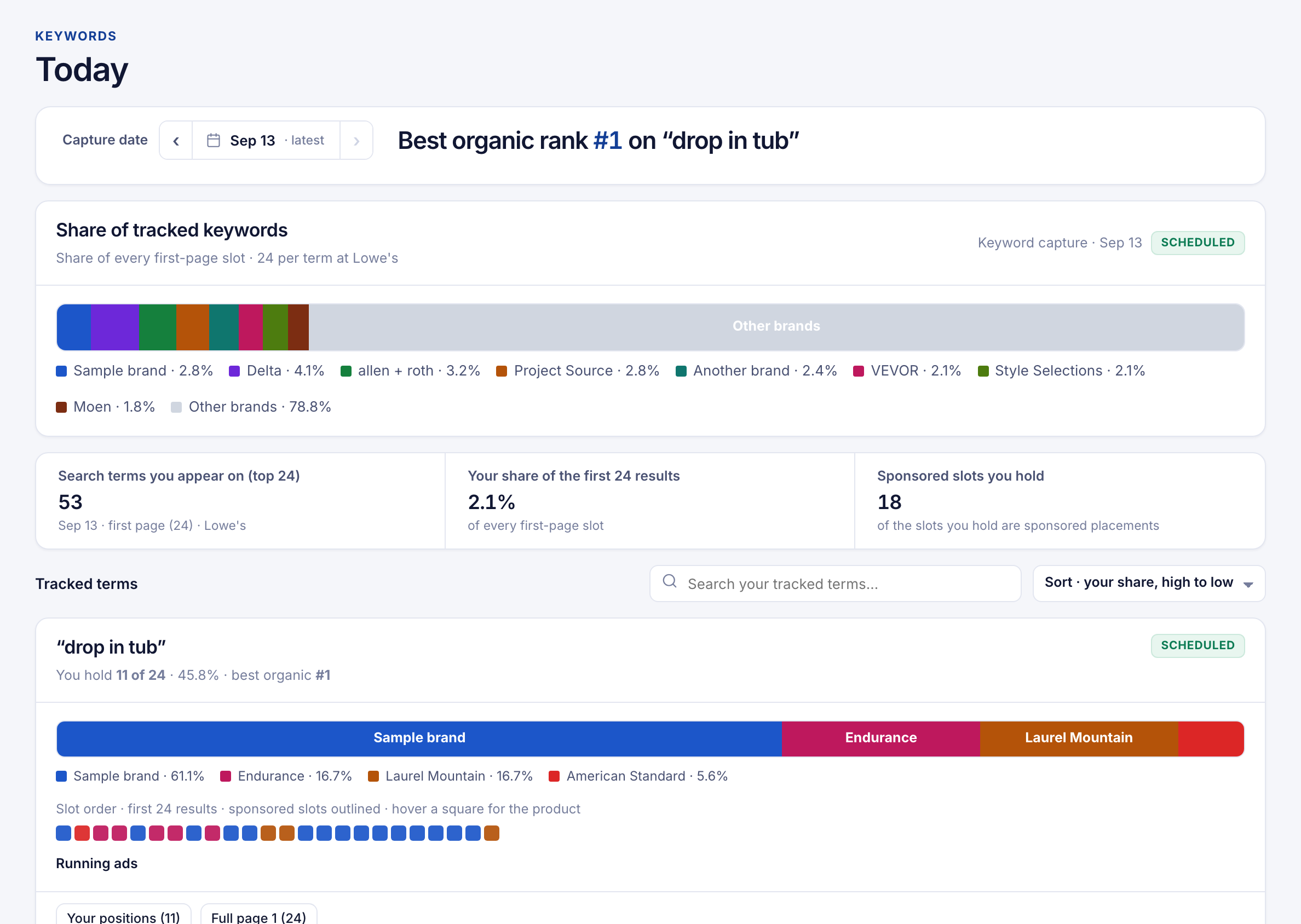
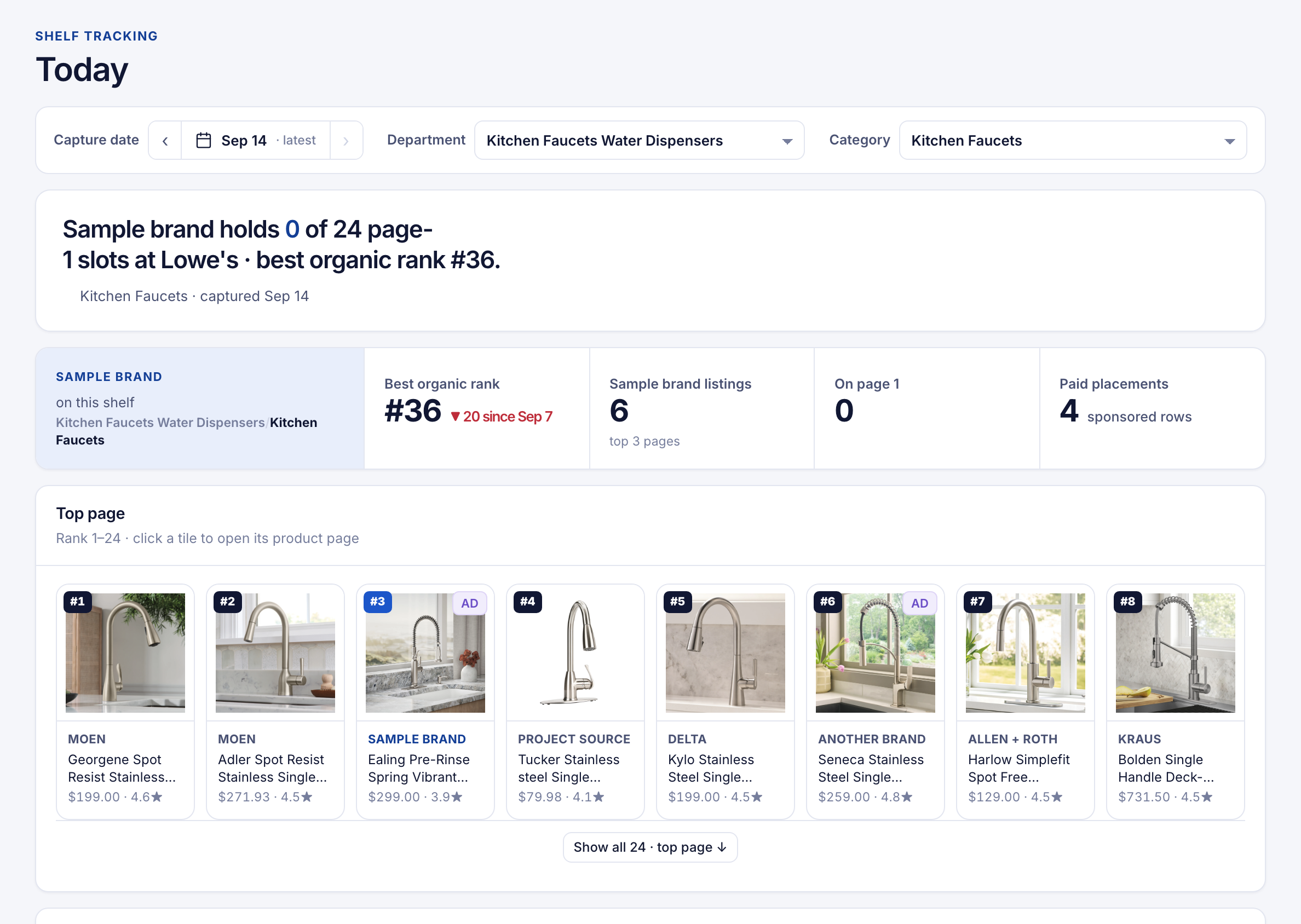
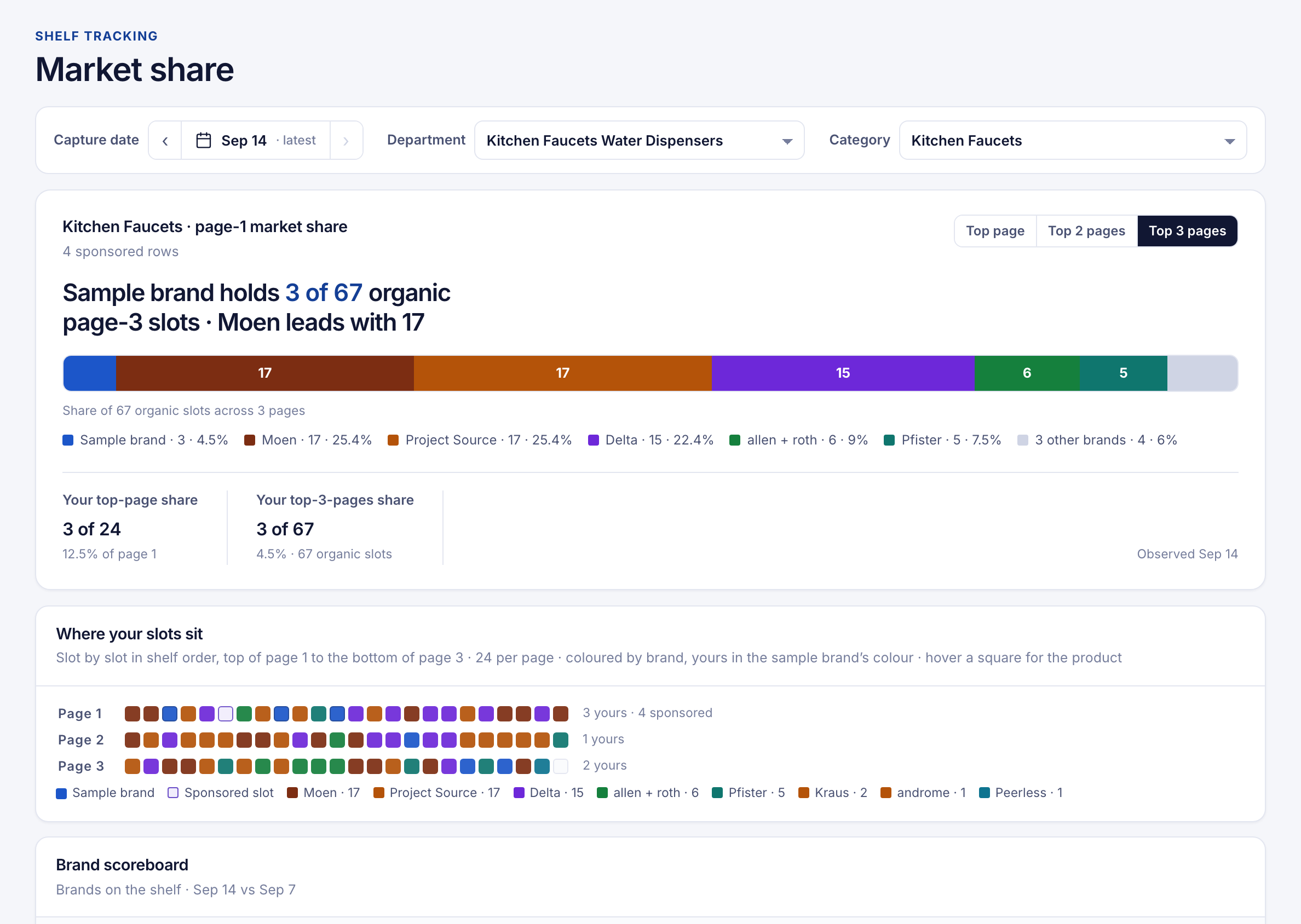
A sample brand’s workspace, tracking kitchen faucets on Lowe’s. The shelf shows where each product sits on page one, and who holds the places around it. Category market share shows every brand’s share of the shelf, the retailer’s own brands included.
Lowe's runs three parallel commercial paths. Most branded goods are sold wholesale (1P): the brand sells inventory to Lowe's through a signed vendor agreement, and Lowe's, not the brand, sets the shelf and online retail price, decides promotions, and controls the product listing content and merchandising placement.
Separately, Lowe's Marketplace lets approved third-party sellers list and price their own items directly to consumers on Lowes.com, with the seller handling fulfillment and Lowe's taking a category-based commission; the seller retains price control within Lowe's marketplace policies but Lowe's controls who is invited to sell and which items are approved as non-duplicative of existing assortment. A third path, most visible in building materials and installed categories, is trade/pro distribution layered on top of retail, including Lowe's 2025 acquisition of Foundation Building Materials for pro-channel distribution. Across all three, the brand cannot unilaterally change the Lowes.com retail price on a 1P listing; it can influence price only through cost, promotion negotiation, or MAP enforcement on its own end.
What Lowe’s shows a supplier natively, and what stays out of view from inside that relationship.
4visible to a brand natively
Sales performance data (units, revenue, sell-through) through the Lowe's Vendor Portal / LowesLink, generally at region or store level, for wholesale (1P) suppliers
Inventory position at Lowe's distribution centers and stores through the same portal
Order, shipment and returns data through Lowe's Vendor Gateway (LVG) for EDI-connected suppliers
For Marketplace sellers: their own order, inventory and fulfillment data on the seller side of Lowe's Marketplace, plus (for advertisers) closed-loop measurement and audience insight reporting sold through Lowe's Media Network
6not visible from inside that relationship
Lowe's category-page ranking and search-relevance logic. Which factors decide default sort order, whether sell-through, margin, sponsored placement, in-stock rate or a blend, is not published.
Any Home Depot performance data: a brand's Home Depot vendor/supplier portal is a separate system with its own metrics, cadence and taxonomy, so a supplier cannot reconcile Lowe's and Home Depot performance in one native view
A native Pro-versus-DIY split of that brand's own sales inside Lowe's, unless Lowe's chooses to report it; Lowe's own disclosed DIY/Pro revenue mix is company-wide, not brand-specific
Store-level or regional price-match activity triggered by Lowe's Lowest Price Guarantee against Home Depot or other competitors on the brand's own SKUs
Full visibility into how Lowe's private-label lines (Kobalt, CRAFTSMAN at Lowe's, allen + roth, Project Source, Origin21, Blue Hawk) are merchandised or promoted relative to the brand's own listings
Marketplace sellers do not receive the 1P vendor's Lowe's-side sales-performance and inventory reporting; the two seller types sit on different portals with different data access
Three products, nine modules, on every retailer you sell on.
Who holds page one of your category, where you show up in search, and who is paying to be there.
Explore ShelfPrice and MAP monitoring in one place: every price against your own sheet, with rival prices beside yours.
Explore PriceWhat changed on the page, whether it is still what you submitted, and whether it is in stock.
Explore ListingNot on a standard wholesale (1P) listing. The brand sells product to Lowe's, and Lowe's sets the retail price, runs promotions, and can adjust price through its Lowest Price Guarantee when it matches a competitor. On Lowe's Marketplace, an approved third-party seller does set its own price, within Lowe's marketplace policies, but that is a separate commercial track from standard wholesale selling.
No. They are separate retailers with separate vendor agreements, separate supplier portals, and typically separate teams inside a brand. Because both retailers carry largely the same national-brand assortment and both run price-match guarantees against each other, a brand effectively runs two parallel retail relationships on the same SKUs, often reading two different sets of sales and inventory data.
Lowe's treats Pro (contractors and tradespeople) and DIY (homeowners) as distinct customer bases with different loyalty programs, pricing mechanics (volume discounts and online quotes for Pro through MyLowe's Pro Rewards), and growth targets set publicly by Lowe's. A brand sold at Lowe's is exposed to both audiences inside one banner but is not natively shown which of its own sales came from which segment.
Not through any Lowe's supplier tool that is publicly documented. Lowe's has not published the logic behind default category-page sort order, so a supplier cannot see, from inside Lowe's own systems, why a competing product or a Lowe's private-label item outranks its own.
Through the Lowe's Vendor Portal (LowesLink) and Vendor Gateway (LVG), a wholesale supplier can see sales performance, inventory position at Lowe's distribution centers and stores, and order/shipment data. Marketplace sellers see their own order and fulfillment data on a separate portal. Neither view includes Home Depot data, competitor shelf position, or a native Pro-versus-DIY breakdown of the brand's own sales.
Lowe's Media Network sells onsite formats (sponsored product listings and premium display on Lowes.com and the app), programmatic display, video, connected TV, streaming audio and podcasts, digital out-of-home, offsite paid search and social media placement, email advertising, and in-store audio, plus audience insights and closed-loop measurement reporting.
Track The Home Depot, Wayfair and Ferguson alongside Lowe’s, and see a move at one retailer against the others.
Thirty minutes with someone who knows your sector, on your brand and the retailers you sell on.


