Defend
See a competitor take a category page position or a private-label line move into your space, in terms of the page, not a spreadsheet export.
Home · Retailers · The Home Depot

The Home Depot’s supplier reporting shows you your own items. Metrics shows the shelf around them: who holds page one, who paid to be there, and where you rank in search.
A view of how a product actually appears on The Home Depot’s category pages and search results, alongside the competitors, private-label lines and paid placement around it. It sits beside The Home Depot’s own supplier reporting rather than replacing it, since that reporting is scoped to a brand’s own items and does not show the shelf around them.
See a competitor take a category page position or a private-label line move into your space, in terms of the page, not a spreadsheet export.
Compare what The Home Depot’s own supplier reporting shows about your items with what is actually on the page around them.
Find where your range is thin against The Home Depot’s private-label and exclusive-brand lines in the same category.
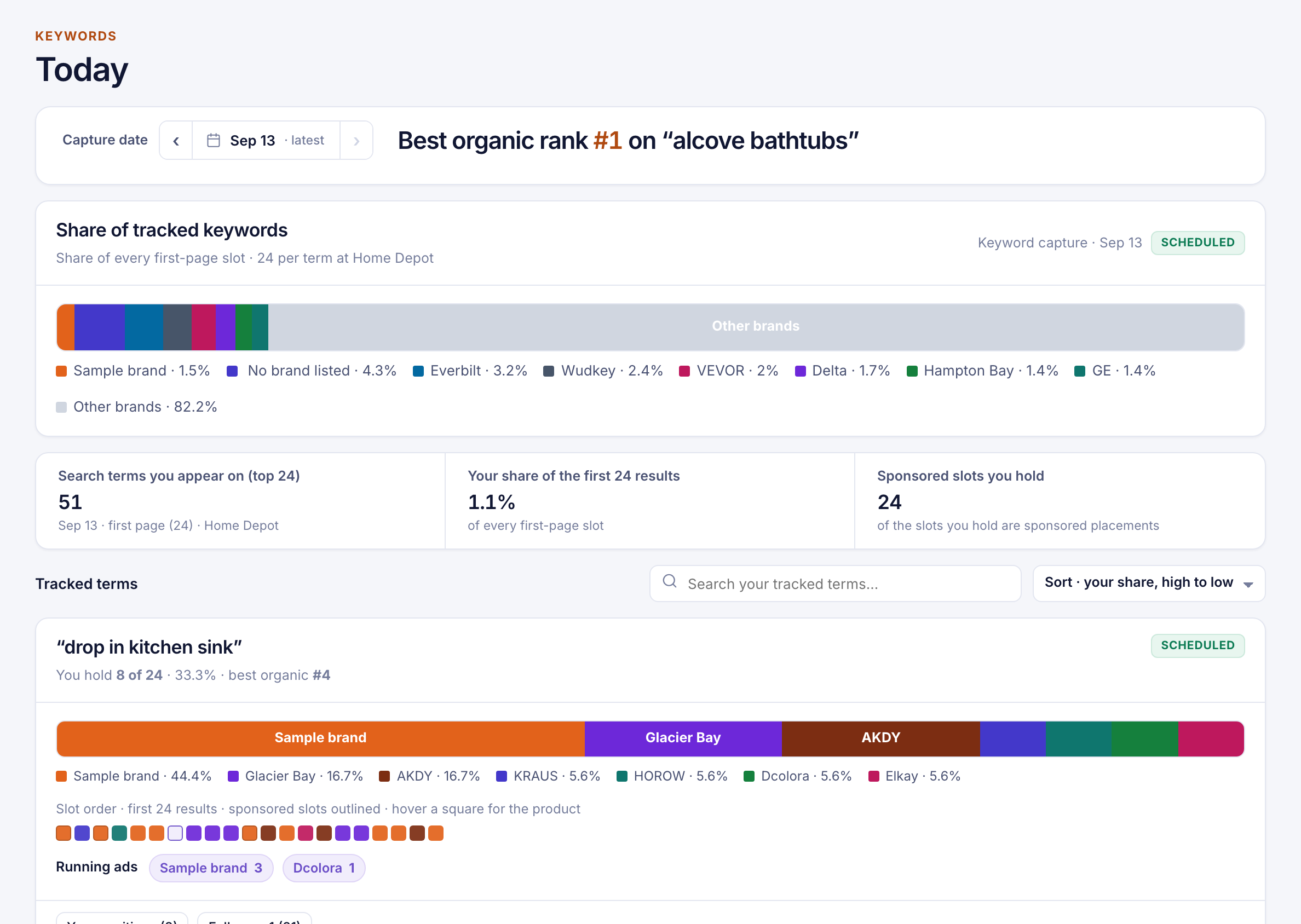
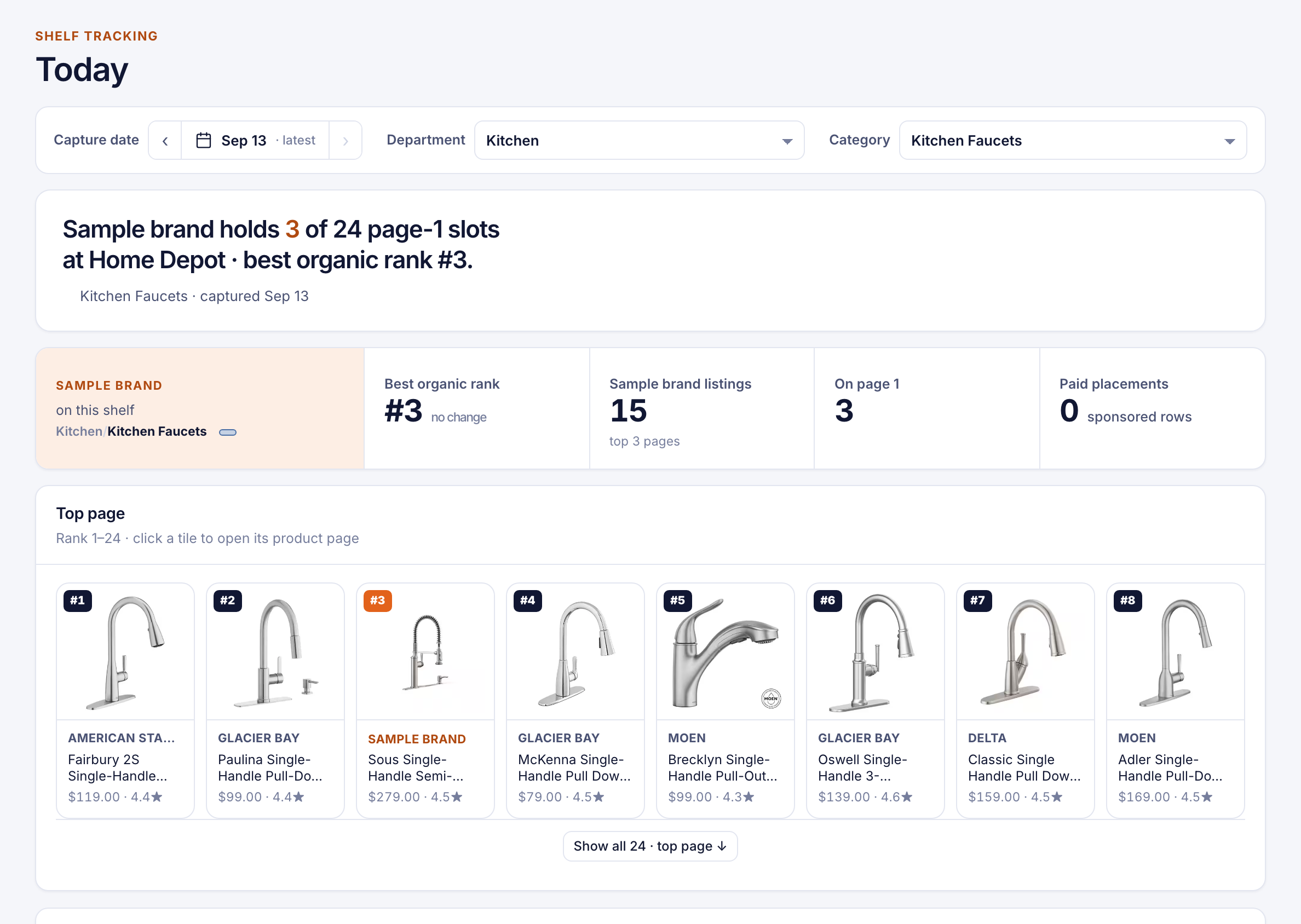
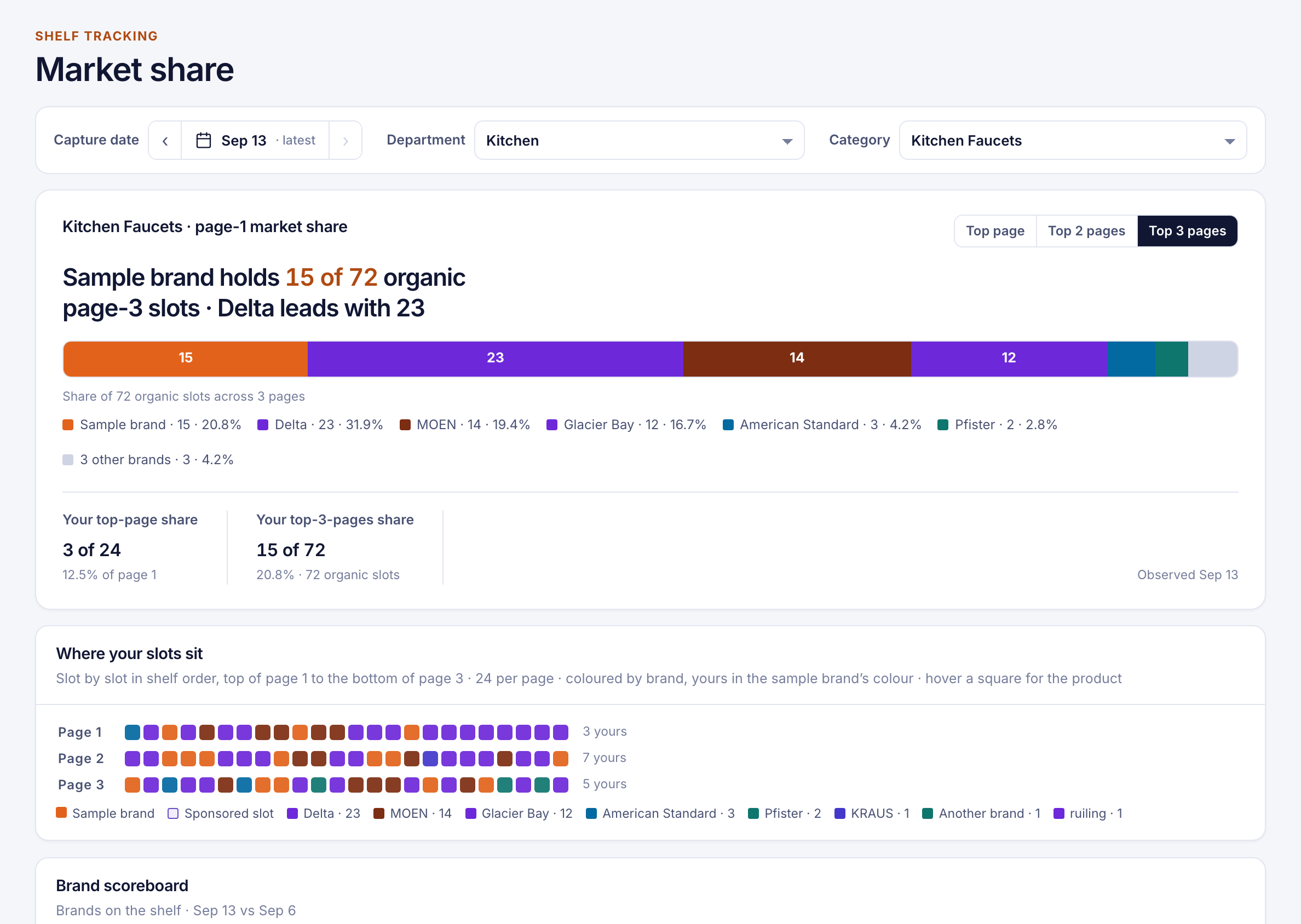
A sample brand’s workspace, tracking kitchen faucets on The Home Depot. The shelf shows where each product sits on page one, and who holds the places around it. Category market share shows every brand’s share of the shelf, the retailer’s own brands included.
Home Depot sells through several distinct commercial lanes, and they carry different amounts of control. In first-party wholesale, Home Depot's merchant team selects and buys inventory through its new product submission process, and Home Depot sets the retail price and controls the listing.
In vendor drop-ship, the supplier holds the inventory and ships direct to the customer once Home Depot lists the item, but Home Depot still owns the page, the buy box and the price. Home Depot Marketplace adds a third-party seller program on top of both, letting outside sellers list and fulfill directly. Pro-facing terms sit over all of it: Pro Xtra members can receive preferred pricing on specific recurring items, badged in the app, online, at checkout and on statements. The net effect for a supplier is that Home Depot, not the brand, sets the shelf price and the account-level price breaks a shopper sees. The brand's leverage is over cost, terms and promotional support, not the retail price itself.
What The Home Depot shows a supplier natively, and what stays out of view from inside that relationship.
5visible to a brand natively
Sales, inventory on hand and out-of-stock counts through the free VendorDrill tier
Under the paid Supplier Analytics Program: unit and dollar sales, units on hand, out-of-stocks, fill rate, fulfillment channel, online sales funnel and planogram data, at daily store-level granularity with roughly three years of history
Three ways into that same data: VendorDrill+ as a self-serve portal, DataConnection as a raw feed into a supplier's own BI tools, and Askuity as a visualization layer with dashboards, trend reporting and regional heat maps
EDI feeds as an additional route to the same sales and inventory data
Its own advertising performance inside Orange Access, Home Depot's self-service retail media platform: onsite product listing and display ad reporting, campaign pacing, and performance dashboards for the campaigns that brand runs
6not visible from inside that relationship
Competitor sales, share or shelf performance at Home Depot. The Supplier Analytics feeds are scoped to the requesting supplier's own items, not to category-wide benchmarking.
A single view tying an ad exposure in Orange Access to the sales data reported through VendorDrill+, DataConnection or Askuity. Those are separate systems, and Home Depot does not describe a joined view between the two.
Basket-level or trip-level shopper data, meaning what else was bought alongside the brand's product and by whom. The reported metrics stop at sales, inventory and funnel stage.
Which shoppers received Pro Xtra preferred pricing or volume pricing on the brand's own items. That pricing sits inside Home Depot's loyalty program rather than in a supplier-facing report.
Marketplace sellers' pricing and listings for competing or identical products, since marketplace seller performance is not part of the supplier feeds.
Any benchmarked view of a Home Depot private-label or exclusive line in the same category, such as Husky, HDX, Glacier Bay or Hampton Bay, since those are Home Depot-controlled rather than third-party supplier accounts.
Three products, nine modules, on every retailer you sell on.
Who holds page one of your category, where you show up in search, and who is paying to be there.
Explore ShelfPrice and MAP monitoring in one place: every price against your own sheet, with rival prices beside yours.
Explore PriceWhat changed on the page, whether it is still what you submitted, and whether it is in stock.
Explore ListingNo. Home Depot sets retail price on both first-party purchased inventory and vendor drop-ship listings; the brand negotiates cost and terms but Home Depot controls the shelf price shown to shoppers, including any Pro Xtra Preferred Pricing or volume-pricing overlays.
A free VendorDrill Standard tier gives sales, inventory-on-hand and out-of-stock counts. A paid Supplier Analytics Program (accessed via VendorDrill+, DataConnection, Askuity or EDI) adds unit and dollar sales, fill rate, fulfillment channel, online sales funnel and planogram data at daily store-level granularity with roughly three years of history.
Orange Access, Home Depot's retail media platform, reports campaign performance (pacing, insights) for the ads a brand buys, but no public source describes a joined view tying that ad exposure directly into the Supplier Analytics Program's POS sales feed; they are separate systems.
Other national brands sorted by the same Top Seller and Best Rated signals, plus Home Depot's own owned private-label lines (Husky, HDX, Glacier Bay, Workforce, Vigoro, EcoSmart) and exclusive-to-Home-Depot lines made by outside manufacturers (Hampton Bay, Home Decorators Collection, certain Ryobi models).
Yes, through Home Depot Marketplace, a third-party seller program layered on top of Home Depot's first-party and vendor drop-ship catalog on homedepot.com.
Named onsite formats include Product Listing Ads, Display Ads, a self-serve Brand Page Portal, and Category Leaderboards, with a Sponsored Brands Display format in development; offsite reach runs through partner integrations with The Trade Desk, Yahoo, Reddit (self-service) and a Pinterest beta, all managed through the Orange Access platform.
Track Lowe’s, Wayfair and Ferguson alongside The Home Depot, and see a move at one retailer against the others.
Thirty minutes with someone who knows your sector, on your brand and the retailers you sell on.


